Live in Quebec · Data hosted in Canada
The system that keeps mobile equipment rental moving
Portable toilets, containers, site trailers. OpsNode plans the routes, guides the driver even offline, proves every visit, and bills what was actually done — instead of paper, text messages, and spreadsheets.

Verified operating figures
Recorded from the production database of a Quebec operator, since it went live on June 17, 2026. Figures verified on July 31, 2026.
An industry still running on paper
Thousands of small and mid-sized businesses rent and service equipment scattered across hundreds of sites. Most run it from memory, over the phone, and in Excel — and it breaks down at scale.
Improvised routes
The route gets decided the same morning, by feel. Wasted mileage, forgotten customers, overtime.
No proof
"Did they actually empty it?"The question nobody could answer — not the client, not the owner.
Revenue that leaks away
Billable visits get lost between the field and the office. Every week, revenue evaporates.
Zero visibility
How many units are out in the field? Which ones are due? The answer lives in the owner's head.
From contract to report, without a single Excel export
Four steps, one system. Built mobile-first, bilingual, and adopted by a driver in a single day.
1. The contract
Multi-site rentals, serialized units, a service schedule defined per piece of equipment. Availability checked by date.
2. The dispatch
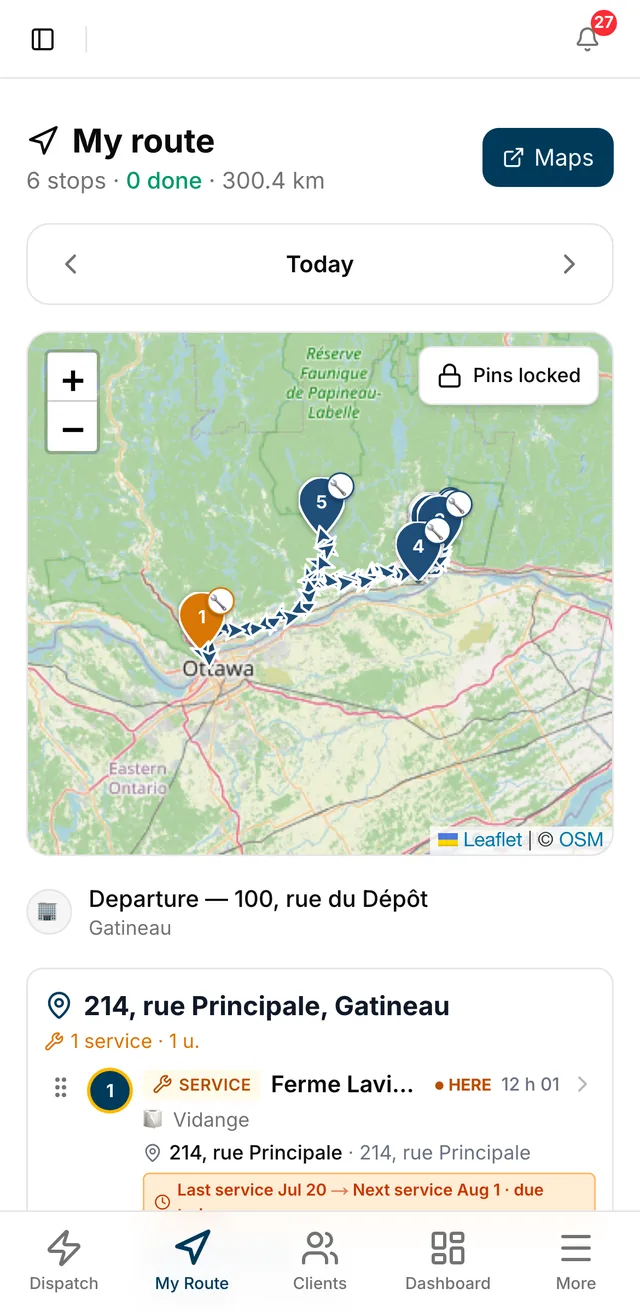
Schedules generate the visits, grouped by address and sequenced on the real road network. A full day is planned in minutes.
3. The field
The driver app, even offline: navigation, time tracking, checklists, photos, GPS. The route re-optimizes the moment something changes.
4. The office
An end-of-day report sent and available on demand, billing, a readable audit trail. The owner follows everything live, on the map.
You know exactly what was done on every unit
Every visit leaves a verifiable trail: the checked steps, the photo, the location, the time, and the driver's name. With a distinction few systems make — a step checked by a person versus a step filled in automatically.
- Checklists by visit type: required, optional, or conditional
- Timestamped photos and location recorded at completion
- The owner sees who did what, and when — without calling anyone
- Report delivered to the client by email, automatically
Service — Pump-out Completed · 8:25 AM
Tank emptied✓ checked by Marc
Tank clean✓ checked by Marc
Clean on arrivalnot applicable
Interior photo2 photos
Location45.884 · −75.892
Next servicein 7 days — scheduled
Six modules, no spreadsheet in between
Everything a rental operator does in a day, in one system — and nothing forces you to re-enter data you already have.
Dispatch and routes
Automatic schedules, grouping by address, sequencing on the road network, capacity per driver.
OSRM routing · depot returnOffline field app
The day's route, navigation, time tracking, checklists — even with no signal on site.
Local queue · replay without duplicatesProof of service
Typed steps (photo, note, signature), the source of every checkmark, location and timestamp.
Conditional step: "if X, photo required"Reports and billing
Configurable end-of-day report, sent and available on demand. PDF invoices, profitability per client, a complete audit trail.
Per-unit detail · photos includedContracts and availability
Multi-site rentals, availability calculated by date, billable visits detected automatically.
Double-booking blocked at the database levelClient confirmations
Every delivery and every pickup confirmed with the client before the truck leaves — no more wasted trips.
Configurable separately: deliveries / pickupsOne model, several trades
What these businesses share isn't the equipment — it's the model: a scattered fleet, a schedule to keep, and proof to provide. OpsNode handles it for each of these trades.
Portable toilets
Scheduled pump-outs, festivals, long-running job sites — with proof of every visit. In production with a Quebec operator.
See the industry pageContainer rental
Delivery, rotation, pickup: the container's full cycle, with the full-for-empty swap planned as a single stop.
See the industry pageSeptic services
Your clients' own assets, serviced on a regulated schedule, on rural routes where every kilometre counts.
See the industry pageEvents
Festivals, weddings, special events: deliver everything before the gates open, pump out daily, pick it all up on Monday. Festivals are served in production.
See the industry pageGrease traps
The restaurant's own asset, pumped on a regulated schedule — with the proof inspectors ask for.
See the industry pageGenerator rental
Maintenance follows the unit, not the contract: oil, filters and refuelling on schedule, swaps in a single trip.
See the industry pageBuilt like a system, not a project
Your operating data is your business. Here is precisely where it lives and how it's protected — no vague reassurances.
Data hosted in Canada
Sovereign hosting in Quebec. Compliant with Quebec's Law 25: anonymization, right to be forgotten, export of personal information on request.
Encryption and access
TLS 1.3 in transit, Argon2id passwords, network isolation per service, a plain-language audit trail — not raw technical IDs.
Continuity
Hot-standby PostgreSQL replica, daily backups replicated off-site, continuous monitoring with alerts.
Bilingual end to end
French and English everywhere: interface, reports, emails sent to your clients. Each client receives everything in their own language.
The engineering behind it
From calendar to sensor: service triggered by actual state
The industry services its equipment on a calendar — whether it needs it or not. What's next for OpsNode: sensors that feed the dispatch. You stop pumping out "every Tuesday" and start pumping out when it's full.
LIVE
The platform
Dispatch, field, proof, billing. In daily use at an operator today.
IN DESIGN
The sensors
Standalone modules mounted on the equipment: level, usage, position.
NEXT
Data-driven dispatch
Sensors create the visits. Fewer kilometers, fewer unnecessary stops.
HORIZON
Fleet intelligence
Demand forecasting, usage-based pricing, fleet data nobody has today.
An architecture designed for margin
- One cellular subscription per siteThe gateway node carries the SIM card; unit sensors talk to it over a radio mesh, with no subscription of their own. The more units, the lower the cost per unit.
- Designed for over two months of battery lifeA design target, depending on the reading frequency chosen.
- Encrypted radio linkUsage data never travels in the clear, even on a shared channel.
Current stage: design. No sensor is deployed in the field yet.
Every module gives you time back to grow
The philosophy is simple: everything that automates the admin work frees the operator to grow their customer base and improve their service. We solidify what exists, then we add.
Wave 1 — the office
Automate the admin
- Automated client billing
- Automatic report delivery by email and SMS
- Quotes with acceptance tracking
- Rental contract management
Wave 2 — the client
Self-service
- Online booking by the client
- Client portal: equipment, services, invoices
- Proof of service accessible to the client
Wave 3 — the fleet
A fleet that manages itself
- Equipment sensors (level, usage)
- Visits created from actual usage
- Predictive maintenance · demand forecasting
One subscription, sized to your fleet
Three published plans — CA$199 to CA$599 per month based on fleet size and vehicle count. Everything is included, and users are unlimited.
What's included, always
- Every operating module — nothing sold as an add-on
- Unlimited users: add a driver without the invoice changing
- Migration of your existing data from Excel
- Continuous updates, no version fees
- Hosting in Canada and backups included
CA$199 to CA$599
per month, based on fleet size and vehicles.
The full grid is public — no sales call required to see it.
What people ask us
What is OpsNode?
OpsNode is a Quebec-built field operations management software for mobile equipment rental: portable toilets, containers, site trailers, generators. It replaces paper, text messages, and spreadsheets with a single system that plans routes, guides the driver offline, keeps proof of every visit, and produces billing and reports. Data is hosted in Canada.
Who is OpsNode for?
Businesses that rent out equipment and have to keep coming back to it: portable toilet and event operators, container and site trailer rental companies, septic services. The common thread isn't the equipment — it's the model: a scattered fleet, a service schedule to keep, and proof to provide the client.
The system is built for fleets ranging from a few dozen to a few thousand units, run by anywhere from one person to a few dozen.
How much does it cost?
The grid is public: CA$199 to CA$599 per month, based on fleet size and vehicle count. Every module is included, users are unlimited — adding a driver doesn't change the invoice — and there are no implementation fees. Details on the Pricing page.
How long does it take to get started?
Your clients, sites, and equipment are imported from Excel. A driver picks up the field app in a single day: it's built to be used one-handed, with gloves on, on site.
Does it work without a network connection on site?
Yes. The field app works offline: time tracking, photos, and checked steps are queued on the device, then synced as soon as signal returns — without creating duplicates.
Does my data leave Canada?
No. Hosting is sovereign, in Quebec, compliant with Quebec's Law 25: anonymization, right to be forgotten, and export of personal information on request. No third-party analytics or advertising service is loaded on this site.
How is OpsNode different from generic field service software?
Generic software thinks in work orders: one task, one technician, one address. OpsNode thinks in rented units: each piece of equipment carries its own serial number, its own service schedule, and its own rental period, and availability is calculated by date rather than by status. That's what lets it refuse a double-booking, bill what was actually promised, and know exactly which unit was serviced.
Are there accounting integrations?
Not yet. Today, OpsNode produces PDF invoices and exports your data to Excel. Accounting connectors are on the roadmap; we don't announce an integration before it ships.
Where do the sensors stand today?
At the design stage. The architecture is settled — a gateway node carrying the SIM card, unit sensors connected over an encrypted radio mesh — but no sensor is deployed in the field yet. We're solidifying the operating modules first. The platform runs entirely without sensors.
What if my drivers won't use the app?
It's built mobile-first: big buttons, few gestures, no unnecessary typing, and it keeps working when the network drops. At the operator running it in production, two drivers keep a fleet of 184 units moving — without paper.
See OpsNode on your own operations
A demo of about thirty minutes, using your real sites and your real routes. You'll see the dispatch, the proof of service, and the reports. Response within one business day.
Or write directly to info@opsnode.ca